
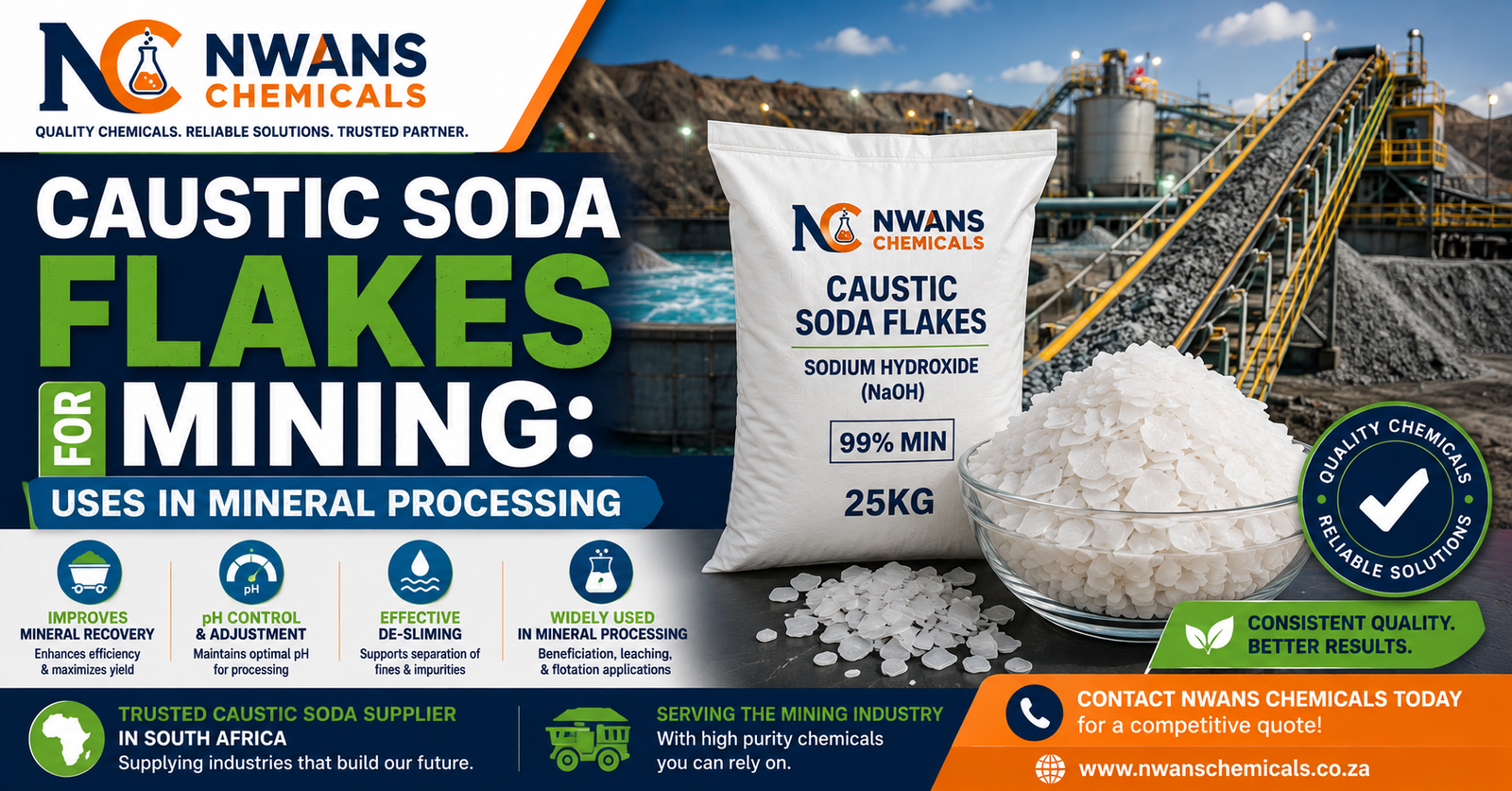
Caustic Soda Flakes for Mining: Uses in Mineral Processing
Mining operations run on precise chemistry, and few reagents are as fundamental to that chemistry as caustic soda. From controlling pH in gold cyanidation to enabling alumina extraction from bauxite, caustic soda flakes play a critical role across multiple stages of mineral processing. This guide covers where and why caustic soda flakes are used in mining, what purity level matters, and what to check when sourcing from a caustic soda supplier South Africa mining operations can rely on.
Why Mining Operations Rely on Caustic Soda
Caustic soda (sodium hydroxide) is a strong alkali, and mineral processing depends heavily on controlling alkalinity at almost every stage — from leaching circuits to flotation and impurity removal. In flotation circuits specifically, precise alkaline conditions optimize mineral separation efficiency, with pH control widely regarded as one of the most critical parameters in successful mineral processing. Because caustic soda is inexpensive relative to the value it protects, it has become a standard reagent across gold, base metal, and alumina processing operations globally.
Key Uses of Caustic Soda Flakes in Mineral Processing
1. pH Control in Gold Cyanidation
Gold extraction commonly relies on cyanide leaching, a process that only works efficiently and safely under alkaline conditions. Caustic soda helps stabilise the cyanide leach solution, supports stripping gold from activated carbon, neutralises acidic residues, and improves the kinetics of cyanide destruction — without adequate alkalinity, pH can drift too low, releasing toxic hydrogen cyanide gas and reducing recovery. Maintaining the correct alkaline pH range is therefore not just a matter of efficiency, but a critical safety control in gold processing plants.
2. Flotation Circuit pH Adjustment
Froth flotation, used to separate valuable minerals from waste rock, depends on tightly controlled pH to achieve selective separation. Sodium hydroxide is commonly used in flotation processes to improve selectivity in copper, gold, and base metal concentration operations. Getting this pH balance right directly affects recovery rates and the purity of the final concentrate.
3. Alumina Extraction (Bayer Process)
One of the largest-volume industrial uses of caustic soda globally is in alumina production. In the Bayer process, concentrated caustic soda dissolves aluminium oxide out of bauxite ore under high temperature and pressure, making it the primary method used worldwide to produce alumina — the precursor to aluminium metal. The same alkaline dissolution reaction separates aluminium-bearing compounds from impurities, allowing pure alumina to be recovered as feedstock for aluminium smelting.
4. Cyanide Detoxification and Tailings Treatment
Beyond extraction itself, caustic soda plays a role in managing the by-products of gold processing. In gold mining and metallurgy, caustic soda contributes to cyanide detoxification processes used to treat tailings before disposal. This is an important part of responsible tailings management, helping operations reduce environmental risk from residual cyanide.
5. Mine Water Treatment
Mining operations also use caustic soda to manage water quality on site. It’s used to treat mine water and remove impurities carried over from tailings, which can otherwise prevent that water being reused in other on-site processes, while also helping to reduce odour issues sometimes associated with mine water. This makes it a dual-purpose reagent — supporting both extraction chemistry and on-site water management.
Why Caustic Soda Flakes Specifically?
While caustic soda is available as flakes, pearls, and liquid lye, flakes remain a practical choice for many mining operations, particularly smaller or mid-scale sites, or those dosing manually or in batches rather than through fully automated liquid feed systems. Flakes dissolve relatively quickly once added to process water, and their high purity (typically 98-99% NaOH) makes them suitable for sensitive processes like cyanide leaching, where impurities can interfere with recovery chemistry.
For larger operations running continuous automated dosing, pearls or liquid lye may be a better operational fit — the right form ultimately depends on your site’s dosing infrastructure and scale, not the process chemistry alone.
Purity Matters More in Mining Than You Might Think
In processes like gold cyanidation and alumina extraction, product purity has a direct impact on recovery efficiency. High-purity sodium hydroxide is generally needed to prevent trace impurities from interfering with extraction chemistry and to protect metallurgical performance. This is why mining operations should always request a Certificate of Analysis (COA) confirming the exact NaOH content and impurity levels of the caustic soda flakes they’re purchasing, rather than relying on general product descriptions.
Safety Considerations for Mining Applications
Caustic soda is corrosive and requires careful handling at every stage of mineral processing:
- Store flakes in a dry, sealed environment, as they readily absorb moisture from the air
- Always add caustic soda to water — never the reverse — to avoid dangerous heat-driven splattering
- Ensure operators handling flakes wear appropriate PPE, including gloves and eye protection
- Maintain proper ventilation in mixing and dosing areas, particularly in enclosed plant environments
- Follow site-specific procedures for cyanide-related processes, where pH control is also a critical safety measure, not just a metallurgical one
What to Check When Sourcing Caustic Soda for Mining
- Purity/assay percentage, with a Certificate of Analysis for every batch
- Consistent particle size and dissolution rate, important for dosing accuracy in leaching and flotation circuits
- Bulk packaging options suited to mine-site logistics — bulk bags, drums, or palletised 25kg bags
- Reliable, scheduled delivery, since interrupted supply can directly halt processing circuits
- Safety Data Sheet (SDS) availability for site safety compliance and operator training
Frequently Asked Questions
1. What is caustic soda used for in gold mining? Caustic soda is used to control pH during cyanide leaching, keeping the process alkaline enough for cyanide to dissolve gold efficiently and safely, while also supporting cyanide detoxification of tailings.
2. Why does pH control matter in mineral processing? pH directly affects the efficiency of leaching and flotation processes. Incorrect pH can reduce recovery rates, compromise product purity, or in cyanide-based processes, create serious safety risks.
3. Is caustic soda used in aluminium production? Yes. Caustic soda is a core reagent in the Bayer process, used to dissolve aluminium oxide from bauxite ore to produce alumina, the raw material for aluminium smelting.
4. Should mining operations use caustic soda flakes, pearls, or lye? It depends on the operation’s dosing infrastructure. Flakes and pearls suit manual or automated solid dosing systems, while liquid lye suits continuous, high-volume automated dosing — the underlying chemistry is the same across all three forms.
5. Why is purity important when buying caustic soda for mining? In sensitive processes like cyanide leaching and alumina extraction, impurities can interfere with recovery chemistry and reduce efficiency, so high-purity product with a Certificate of Analysis is essential.
6. Can caustic soda be used for mine water treatment as well as ore processing? Yes. Beyond its role in extraction and flotation, caustic soda is also used to treat mine water and manage impurities from tailings on site.
Source Reliable Caustic Soda Flakes for Your Mining Operation
Consistent purity and dependable supply matter when your process depends on it. Nwans Chemicals supplies high-purity caustic soda flakes for gold processing, flotation, alumina extraction, and mine water treatment applications across South Africa, backed by full documentation and reliable delivery. Contact us for a tailored quote today.
Leave A Comment