
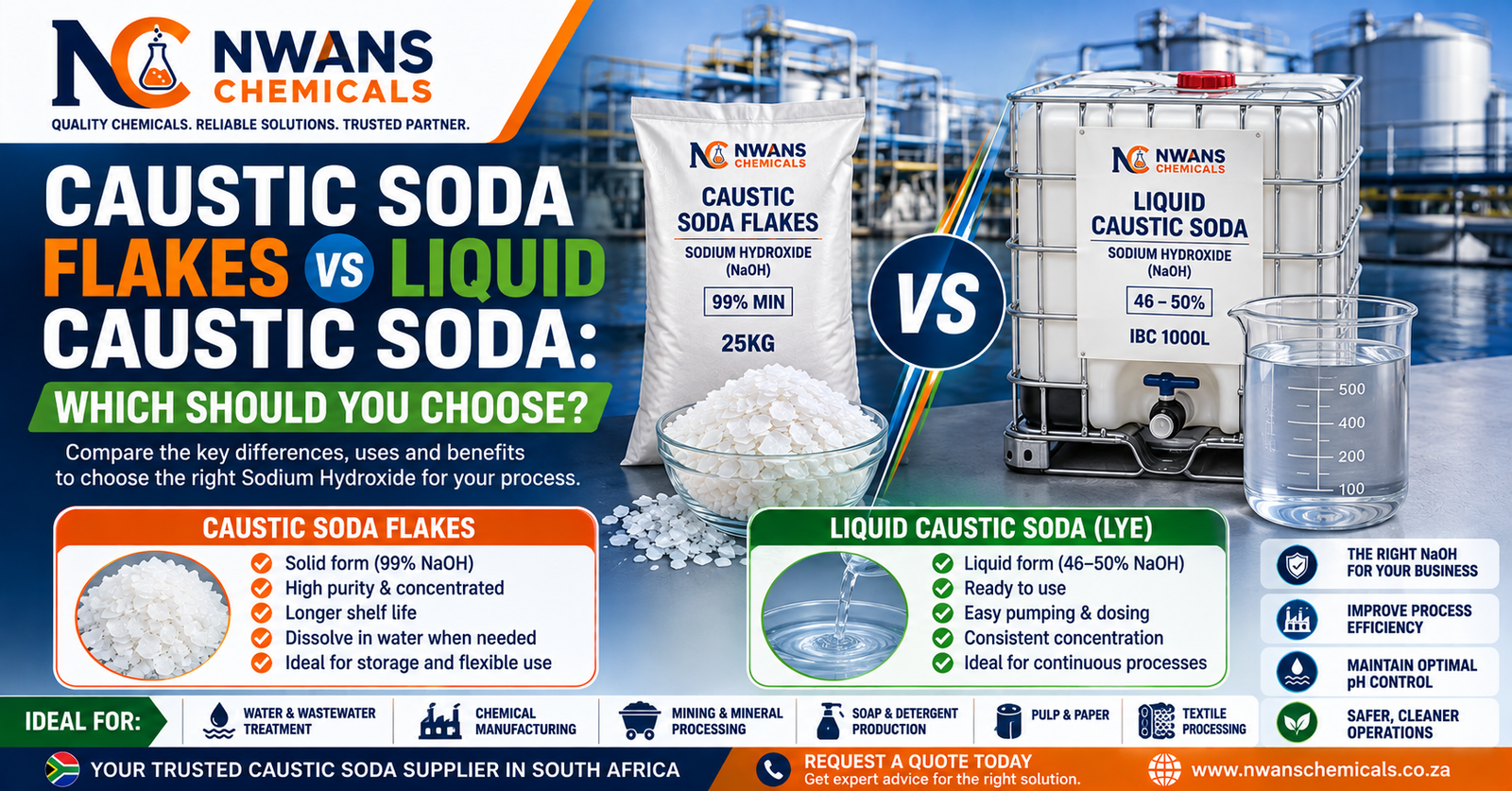
Caustic Soda Flakes vs Pearls: What Is the Difference?
Flakes and pearls are both solid caustic soda, both typically 98-99% pure — so why does it matter which one you order? The difference isn’t in the chemistry, but in shape, handling, and how each performs in your dosing process. This guide breaks down exactly what separates caustic soda flakes from caustic soda pearls, so you can choose the right one for your operation.
Same Chemical, Different Shape
Caustic soda flakes and pearls are both solid sodium hydroxide, produced to a similar purity range and delivering identical chemistry once dissolved in water. The core distinction between them is physical form. Flakes are thin, irregular, flat pieces produced by cooling molten sodium hydroxide, while pearls are small, uniform spherical granules produced through a different solidification process, sometimes described as resembling caviar or fish roe in appearance. That single difference in shape drives nearly every practical distinction between the two products — from dust generation to dosing accuracy to flow through automated equipment.
Caustic Soda Flakes vs Pearls: Side-by-Side Comparison
| Factor | Flakes | Pearls |
|---|---|---|
| Shape | Thin, irregular, flat pieces | Small, uniform spheres |
| Purity | Typically 98-99% NaOH | Typically 98-99% NaOH |
| Dust generation | Higher, due to irregular edges | Lower, due to smooth uniform surface |
| Dissolution | Fast, due to high surface area | Fast and even, due to uniform size |
| Flow through equipment | Can vary, may cause clogging in feeders | Free-flowing, well suited to automated dosing |
| Dosing accuracy | Good for manual/batch dosing | Excellent for automated, precision dosing |
| Typical cost | Generally lower | Often a modest premium due to production process |
| Common industries | Soap making, general industrial processing | Water treatment, automated chemical processing |
Why Shape Matters More Than You’d Think
Dust and Handling
Because flakes have irregular, sometimes sharp edges, they tend to generate more dust during handling, pouring, and mixing than pearls, whose smooth, uniform surface produces comparatively less airborne dust. For operations with strict workplace safety standards, or facilities handling large volumes daily, this difference can meaningfully affect operator exposure and housekeeping requirements.
Dosing Accuracy and Automated Feeding
Pearls’ consistent size and shape make them flow more predictably through hoppers, screw feeders, and pneumatic conveyors — equipment commonly used in automated dosing systems. Flakes, being irregular in size and shape, are more prone to inconsistent flow or occasional clogging in this type of equipment, which is why many facilities running automated or continuous dosing specify pearls over flakes in their procurement requirements.
Dissolution Behaviour
Both forms dissolve readily in water and release heat as they do, but they behave slightly differently. Flakes dissolve quickly due to their high surface-area-to-volume ratio, while pearls dissolve both quickly and evenly, thanks to their uniform particle size — an advantage in processes where consistent dissolution timing matters for downstream dosing accuracy.
Which Should You Choose?
Choose Flakes If:
- You’re dosing manually or in batches rather than through automated feed systems
- Cost efficiency is a priority and dust exposure can be adequately managed with PPE and ventilation
- You’re in an application like soap and detergent manufacturing, where flakes are widely used and well understood
- Your process doesn’t rely on precision automated feeding equipment
Choose Pearls If:
- Your facility uses automated or continuous solid dosing systems
- Minimising airborne dust is a workplace safety priority
- You need highly consistent, repeatable dosing accuracy
- You’re operating in sectors like water treatment or mineral processing, where dosing precision and equipment reliability directly affect process outcomes
Storage and Safety: What’s the Same for Both
Regardless of which form you choose, both flakes and pearls require the same core precautions:
- Store in a dry, sealed, well-ventilated area — both forms are hygroscopic and absorb moisture from the air
- Always add to water, never add water to the solid product, to avoid dangerous heat-driven splattering
- Avoid contact and storage near reactive metals such as aluminium, zinc, and galvanized steel, which can react with sodium hydroxide to release flammable hydrogen gas
- Ensure operators wear appropriate PPE — gloves, eye and, where needed, respiratory protection
- Keep containers tightly closed and clearly labelled at all times
Frequently Asked Questions
1. Are caustic soda flakes and pearls chemically different? No. Both are sodium hydroxide (NaOH) at similarly high purity, typically 98-99%. The only meaningful difference is physical shape, which affects handling, dust generation, and dosing behaviour.
2. Which is better for automated dosing systems — flakes or pearls? Pearls are generally better suited to automated dosing, since their uniform spherical shape flows more consistently through hoppers and feeders and is less prone to clogging than irregularly shaped flakes.
3. Do pearls cost more than flakes? Pearls often carry a modest price premium over flakes, reflecting their more specialised production process, though the exact difference varies by supplier and market conditions.
4. Which produces less dust — flakes or pearls? Pearls typically generate less airborne dust than flakes, due to their smooth, uniform surface compared to the irregular, sometimes sharp edges of flakes.
5. Can I substitute pearls for flakes (or vice versa) in my process? In most cases yes, since the chemistry is identical — but check your dosing equipment and process requirements first, as switching forms may affect flow behaviour, dust management, and dosing accuracy.
6. Which form is more common in water treatment applications? Pearls are frequently preferred in water treatment due to their consistent dosing behaviour and lower dust generation, particularly in facilities using automated solid feed systems, though flakes are also used in smaller or manual-dosing setups.
Not Sure Which Form Is Right for You?
Whether your process calls for caustic soda flakes or caustic soda pearls, Nwans Chemicals can help you choose the right form for your operation — from mining chemical applications to water treatment supply. Contact us for a tailored quote today.
Leave A Comment