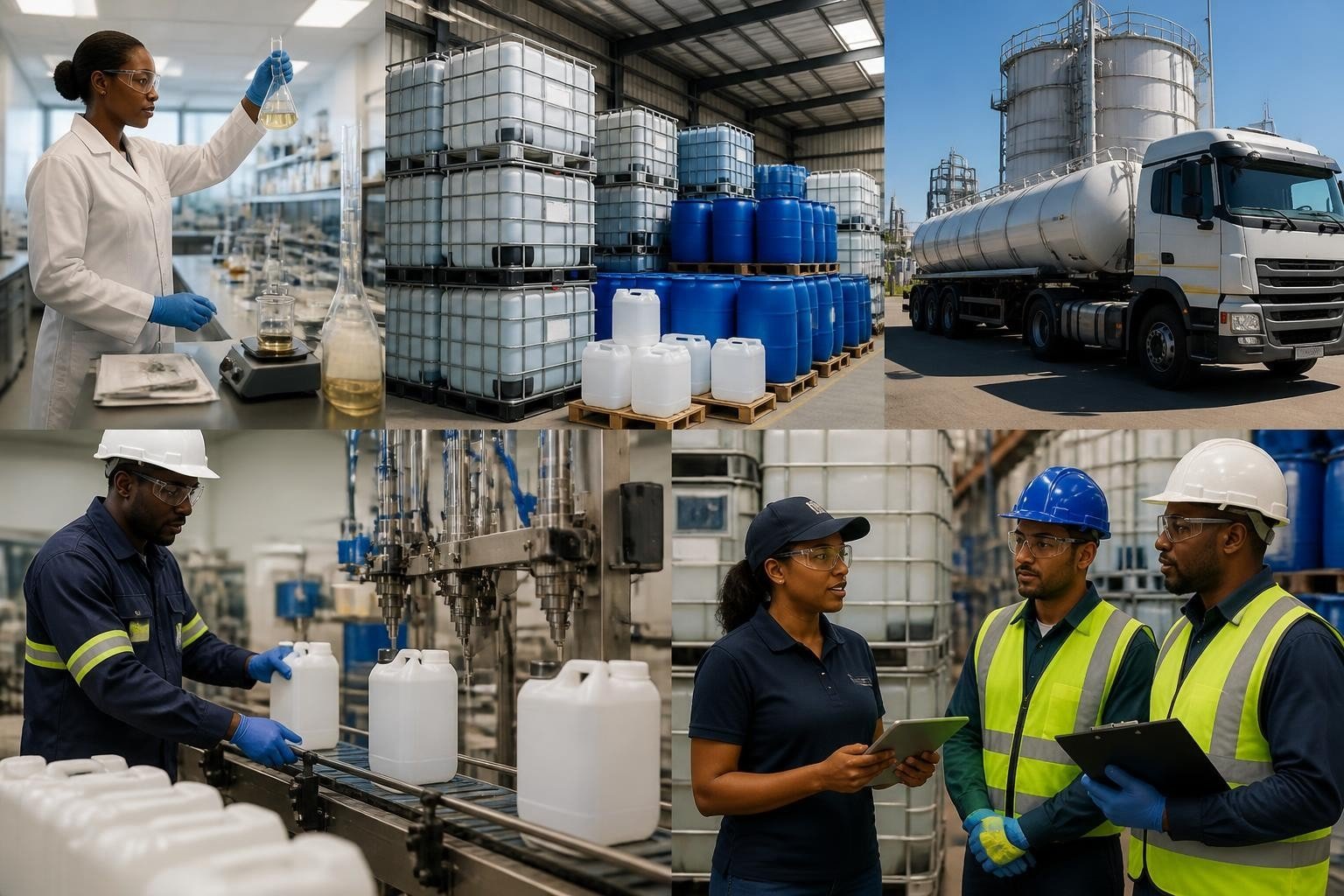
Chemical services encompass far more than simply purchasing products off a shelf. In 2026, industrial businesses, mining operations, water treatment facilities, and manufacturers across South Africa and the broader African market rely on comprehensive chemical services that include sourcing, quality assurance, technical support, logistics coordination, regulatory compliance assistance, and custom packaging solutions. Understanding the full scope of chemical services available helps procurement managers make informed decisions that optimize operational efficiency, ensure product quality, and maintain regulatory compliance throughout their supply chain.
Understanding the Scope of Chemical Services
Modern chemical services extend across the entire value chain, from initial product selection through final delivery and ongoing technical support. Industrial buyers require partners who offer more than commodity chemicals, they need suppliers who understand application-specific requirements, industry regulations, and operational challenges unique to their sectors.
Core Service Categories
Chemical service providers typically offer several distinct categories of support that address different aspects of the procurement and utilization process:
Product sourcing and procurement – Identifying, evaluating, and securing chemical products from domestic and international manufacturers
Quality control and testing – Laboratory analysis, certification documentation, and batch-to-batch consistency verification
Technical consultation – Application guidance, dosage optimization, process troubleshooting, and product selection assistance
Logistics and distribution – Warehousing, transportation, delivery scheduling, and inventory management
Regulatory compliance support – Safety data sheets, regulatory documentation, hazard classification, and environmental reporting assistance
Custom packaging and formulation – Repackaging bulk chemicals into customer-specified quantities, blending custom formulations
The breadth of chemical services required varies significantly based on industry sector, application complexity, and operational scale. Mining operations processing sulphide ores demand different service levels than agricultural businesses purchasing crop protection chemicals.

Chemical Sourcing and Procurement Services
Effective chemical sourcing represents one of the most critical chemical services for industrial buyers seeking reliable supply, competitive pricing, and consistent product quality. Professional sourcing services connect customers with vetted manufacturers, negotiate favorable terms, and manage the complexities of international trade.
Strategic Sourcing Advantages
Working with experienced chemical sourcing partners delivers measurable benefits that extend beyond simple price comparison. These services provide access to global supply networks, manufacturer relationships built over years, and market intelligence that individual buyers rarely possess.
Manufacturer evaluation and qualification forms the foundation of professional sourcing services. Reputable providers assess potential suppliers based on production capacity, quality management systems, regulatory compliance, financial stability, and track record. This due diligence protects buyers from substandard products, supply disruptions, and regulatory violations.
Price negotiation and contract management leverage collective purchasing power and industry expertise. Experienced sourcing teams understand market dynamics, seasonal pricing fluctuations, and leverage points that secure competitive rates for bulk quantities. Long-term supply agreements provide price stability and guaranteed availability.
International vs. Domestic Sourcing
Factor | International Sourcing | Domestic Sourcing |
|---|---|---|
Price competitiveness | Often lower unit costs | Higher unit costs, lower logistics costs |
Lead times | 30-90 days typical | 1-14 days typical |
Minimum order quantities | Larger (container loads) | Flexible, smaller quantities available |
Quality consistency | Variable, requires vetting | Generally consistent, easier verification |
Regulatory complexity | Import permits, customs, duties | Simplified documentation |
Supply chain risk | Higher (shipping, geopolitics) | Lower, more control |
The optimal sourcing strategy often combines both approaches, securing bulk volumes internationally while maintaining domestic suppliers for urgent requirements and smaller quantities. Professional chemical services help structure these hybrid models effectively.
Quality Assurance and Testing Services
Quality assurance represents a non-negotiable component of comprehensive chemical services, particularly for applications where product purity, composition, or physical properties directly impact process performance or product quality. Third-party testing, batch certification, and ongoing quality monitoring protect buyers from costly operational disruptions.
Laboratory Analysis and Certification
Independent laboratory testing verifies that chemical products meet specified grades, purity levels, and performance characteristics before they enter production processes. Standard test protocols include:
Compositional analysis (spectroscopy, chromatography, titration)
Physical property testing (density, viscosity, pH, particle size distribution)
Trace contaminant detection
Performance testing under application-specific conditions
Compliance verification against industry standards (ASTM, ISO, local regulations)
Certificate of Analysis (CoA) documentation accompanies each batch, providing traceability and quality evidence required for regulatory compliance and internal quality management systems. Manufacturing operations following ISO 9001 or industry-specific standards require this documentation to maintain certification.
Batch-to-Batch Consistency
Consistent product performance across multiple deliveries matters significantly for industrial processes optimized around specific chemical characteristics. Variability in raw material quality creates process instability, product defects, and increased operational costs.
Professional chemical services implement quality monitoring protocols that track batch variations over time, identify trends, and flag deviations before they impact customer operations. Statistical process control methods applied to chemical supply chains provide early warning of quality drift.
Technical Support and Application Services

Technical expertise separates commodity chemical suppliers from value-added service providers. Application engineers, chemists, and industry specialists help customers optimize chemical usage, troubleshoot process issues, and improve operational efficiency through proper product selection and implementation.
Product Selection and Optimization
Choosing the right chemical product for specific applications requires understanding both the chemistry and the operational context. Technical service teams evaluate customer requirements, process conditions, performance objectives, and constraints to recommend optimal solutions.
For water treatment applications, selecting between different coagulants depends on raw water characteristics, treatment objectives, existing infrastructure, and operational costs. Water treatment chemicals require careful matching to specific conditions for optimal performance and cost-effectiveness. Technical support services conduct jar tests, pilot trials, and process audits to identify the most effective products and dosing strategies.
Mining operations benefit significantly from application-specific technical services. Flotation reagent selection, grinding aid optimization, and tailings treatment programs require deep understanding of ore mineralogy, circuit design, and process objectives. Experienced chemical service providers work alongside metallurgists and process engineers to develop customized reagent programs that maximize recovery and minimize costs.
Process Troubleshooting and Optimization
When chemical processes underperform or encounter unexpected issues, rapid technical support minimizes downtime and production losses. Diagnostic services identify root causes, whether related to product quality, dosing errors, process condition changes, or equipment problems.
Systematic troubleshooting follows structured methodologies:
Problem definition and data collection – Document symptoms, timeline, process conditions, and recent changes
Hypothesis development – Identify potential causes based on chemistry, process knowledge, and similar cases
Testing and validation – Conduct controlled tests to confirm or eliminate hypotheses
Solution implementation – Apply corrective actions with proper monitoring
Verification and documentation – Confirm resolution and document findings for future reference
Logistics and Distribution Services
Efficient logistics distinguish reliable chemical services from inconsistent suppliers. Transportation, warehousing, inventory management, and delivery coordination require specialized infrastructure, regulatory compliance, and operational expertise specific to chemical handling.
Transportation and Handling
Chemical transportation involves significant regulatory requirements and safety considerations. Hazardous materials regulations govern packaging, labeling, documentation, vehicle specifications, driver training, and emergency response procedures.
Professional chemical distribution services maintain compliant transportation capabilities including:
Licensed hazardous materials transporters
Appropriate vehicle fleet (tankers, flatbeds, refrigerated units)
Proper containment and spill response equipment
Trained drivers with hazmat certifications
Insurance coverage for chemical cargo
Bulk chemical deliveries require coordination between supplier, transporter, and customer to ensure receiving facilities can accommodate delivery vehicles, possess appropriate unloading equipment, and have storage capacity available. Bulk chemical supply logistics become increasingly complex for remote locations or cross-border shipments.
Warehousing and Inventory Management
Strategic warehouse locations reduce delivery times and transportation costs while ensuring product availability for urgent requirements. Temperature-controlled storage, segregation of incompatible materials, and proper ventilation protect product quality and maintain safety.
Service Element | Customer Benefit |
|---|---|
Vendor-managed inventory | Automatic replenishment, reduced stockouts |
Consignment stock | Lower working capital, pay on usage |
Just-in-time delivery | Minimize on-site storage requirements |
Emergency stock reserves | Rapid response to unexpected demand |
Multi-location warehouses | Faster delivery, lower freight costs |
Inventory management services relieve customers of warehousing burdens, capital tied up in stock, and obsolescence risks. Integrated supply agreements with automatic replenishment based on usage patterns ensure continuous availability without excessive inventory investment.
Custom Packaging and Formulation Services
Standard packaging configurations don’t suit every application or operational context. Custom packaging services repackage bulk chemicals into customer-specified quantities, containers, and labeling formats that optimize handling, storage, and usage.
Repackaging Solutions
Bulk chemicals typically ship in standard formats (drums, intermediate bulk containers, bulk bags, tankers) that may not align with customer requirements. Custom packaging services transfer products into:
Smaller containers for laboratory or small-scale use
Specialized packaging for automated dispensing systems
Customer-branded containers for resale or distribution
Certified packages for air freight or international shipping
Returnable containers for closed-loop systems
Repackaging requires appropriate facilities, equipment, and procedures to maintain product integrity, prevent contamination, and ensure worker safety. Professional services operate under Good Manufacturing Practices (GMP) for pharmaceutical and food-grade chemicals.
Custom Formulations and Blending
Some applications benefit from pre-blended chemical formulations tailored to specific requirements. Blending services combine multiple chemicals in precise ratios, creating ready-to-use products that simplify handling and reduce mixing errors.
Custom formulations serve applications including:
Industrial cleaning compounds with optimized surfactant, alkalinity, and chelating agent ratios
Water treatment programs combining coagulants, flocculants, and pH adjusters
Agricultural formulations blending active ingredients with carriers and adjuvants
Specialty chemical blends for niche industrial applications
Formulation development involves laboratory testing, stability studies, compatibility verification, and performance validation before commercial production. Quality control during manufacturing ensures batch-to-batch consistency.
Regulatory Compliance and Documentation Services

Chemical regulations continue expanding in complexity and scope across jurisdictions. Compliance services help customers navigate regulatory requirements, maintain necessary documentation, and adapt to changing rules without diverting internal resources from core business activities.
Safety Data Sheets and Hazard Communication
Safety Data Sheets (SDS) provide essential hazard information, safe handling procedures, and emergency response guidance required under workplace safety regulations. Professional chemical services supply current, jurisdiction-specific SDS formatted according to the Globally Harmonized System (GHS) standards that many countries have adopted.
Regulatory updates require periodic SDS revisions. Service providers monitor regulatory changes and proactively update documentation, ensuring customers maintain current information without manual tracking efforts.
Environmental Compliance Support
Environmental regulations govern chemical storage, usage reporting, waste management, and emissions for many industrial operations. Compliance services assist with:
Facility permitting and license applications
Usage reporting and emission inventories
Waste characterization and disposal documentation
Spill prevention and response planning
Audit preparation and regulatory inspections
Mining and manufacturing operations face particularly complex environmental compliance requirements. Expert guidance helps navigate these obligations while minimizing compliance costs and regulatory risks.
Industry-Specific Chemical Services
Different industrial sectors require specialized knowledge, products, and service approaches that generic chemical suppliers cannot adequately address. Industry-focused chemical services deliver superior value through deep sector expertise and application-specific solutions.
Mining Industry Services
Mining chemicals and related services support mineral processing operations throughout the extraction and beneficiation process. Specialized service elements include:
Metallurgical testing and reagent optimization – Laboratory flotation tests, settling tests, and process audits identify optimal reagent suites and dosing strategies for specific ore bodies. As ore grades decline and mineralogy becomes more complex, systematic reagent optimization delivers measurable improvements in recovery and operating costs.
Process monitoring and control – Automated reagent dosing systems with real-time process feedback optimize chemical consumption and process performance. Service providers assist with control system design, implementation, and ongoing optimization.
Reagent consumption analysis – Detailed tracking of reagent usage per ton processed identifies optimization opportunities and benchmarks performance against industry standards or similar operations.
Water Treatment Services
Municipal and industrial water treatment operations require reliable chemical supply combined with technical support for process optimization and regulatory compliance. Water treatment chemical services typically include:
Jar testing and treatability studies for new water sources
Process optimization to minimize chemical consumption and sludge production
Compliance assistance for drinking water quality standards
Emergency response for water quality incidents
Operator training on chemical handling and dosing
Seasonal water quality variations, source water changes, and evolving regulations create ongoing challenges that benefit from continuous technical support rather than transactional chemical supply relationships.
Industrial Manufacturing Services
Manufacturing operations across diverse sectors utilize chemicals in production processes, cleaning operations, water systems, and waste treatment. Service requirements vary significantly by industry, but common elements include:
Production schedule alignment and delivery flexibility
Quality consistency to prevent production disruptions
Technical support for process changes or new product development
Inventory management to minimize working capital
Custom packaging for production line integration
The role of specialized service providers, including contract development and manufacturing organizations, continues expanding as companies focus on core competencies and outsource specialized chemical functions.
Selecting the Right Chemical Service Provider
Choosing chemical service partners represents a strategic decision with long-term implications for operational efficiency, product quality, and supply chain resilience. Systematic evaluation ensures selection of providers capable of meeting current requirements while adapting to future needs.
Key Selection Criteria
Technical capability and expertise – Evaluate the provider’s knowledge of your industry, application experience, and technical staff qualifications. Request case studies demonstrating successful problem-solving in similar applications.
Supply chain reliability – Assess warehousing locations, inventory levels, backup suppliers, and contingency plans for supply disruptions. Review on-time delivery performance and order fill rates.
Quality systems – Verify quality management certifications (ISO 9001), laboratory capabilities, and quality documentation practices. Request sample Certificates of Analysis and quality audit reports.
Financial stability – Evaluate the provider’s financial health, ownership structure, and business continuity plans. Financially unstable suppliers create supply chain risks regardless of technical capabilities.
Regulatory compliance – Confirm proper licenses, permits, insurance coverage, and regulatory compliance history. Review safety performance metrics and incident records.
Service breadth and integration – Consider whether the provider offers complementary services that could simplify your supply chain, such as combining sourcing, logistics, and technical support.
Partnership vs. Transactional Relationships
Chemical services deliver maximum value through collaborative partnerships rather than purely transactional purchasing relationships. Partnership characteristics include:
Transparent communication – Open sharing of challenges, requirements, and constraints from both parties
Aligned incentives – Contract structures that reward performance improvement and cost optimization
Continuous improvement focus – Regular reviews to identify optimization opportunities
Long-term commitment – Multi-year agreements that justify investment in customer-specific solutions
Risk sharing – Collaborative approaches to managing price volatility, supply disruptions, and operational challenges
Organizations following Responsible Care principles demonstrate commitment to safety, security, and environmental performance throughout their operations and supply chains. Partnership with providers maintaining these standards reduces your operational risks and supports your sustainability objectives.
Digital Transformation in Chemical Services
Technology adoption continues reshaping chemical services, enabling enhanced efficiency, transparency, and customer experience. Digital tools increasingly differentiate leading service providers from traditional commodity suppliers.
E-Commerce and Digital Ordering
Online portals provide 24/7 access to product information, pricing, inventory availability, and order placement. Digital systems streamline procurement processes, reduce administrative costs, and improve order accuracy.
Advanced platforms offer features including:
Real-time inventory visibility across multiple warehouse locations
Automated reordering based on usage patterns
Order tracking and delivery notifications
Digital documentation (SDS, CoA, invoices)
Usage analytics and reporting dashboards
Supply Chain Visibility and Tracking
Digitally-enabled supply chains provide unprecedented transparency from manufacturer through final delivery. GPS tracking, automated status updates, and predictive delivery windows help customers plan receiving operations and minimize unproductive waiting time.
Blockchain applications in chemical supply chains create immutable records of product origin, custody chain, and quality documentation. While still emerging in 2026, these technologies address traceability requirements for regulated industries and quality-sensitive applications.
Predictive Analytics and Optimization
Data analytics applied to chemical usage patterns, process conditions, and performance outcomes identify optimization opportunities invisible through manual analysis. Machine learning models predict optimal reorder timing, forecast demand fluctuations, and recommend process adjustments to improve efficiency.
Predictive maintenance applications analyze chemical consumption patterns to identify equipment issues before failures occur. Unexpected increases in water treatment chemical usage may indicate membrane fouling, heat exchanger scaling, or process upsets requiring attention.
Cost Optimization Through Strategic Chemical Services
Effective chemical services deliver measurable cost reductions beyond simple unit price negotiations. Total cost of ownership perspectives reveal optimization opportunities across procurement, inventory, logistics, quality, and operational efficiency.
Total Cost Analysis Framework
Cost Category | Optimization Opportunities |
|---|---|
Purchase price | Volume commitments, long-term contracts, alternative products |
Freight and logistics | Consolidated shipments, optimal order quantities, warehouse proximity |
Inventory carrying costs | Vendor-managed inventory, consignment, just-in-time delivery |
Quality failures | Better specifications, testing, supplier qualification |
Handling and storage | Improved packaging, reduced handling steps |
Waste and disposal | Optimized dosing, reduced overage, better shelf-life management |
Technical support costs | Preventive optimization, training, documentation |
Comprehensive chemical services address multiple cost categories simultaneously, delivering savings that exceed the service fees. A mining operation reducing flotation reagent consumption by 5% through technical optimization easily justifies service costs while simultaneously improving recovery.
Demand Forecasting and Planning
Collaborative demand planning between customers and chemical service providers smooths ordering patterns, reduces expedite fees, and enables more efficient logistics. Sharing production schedules, maintenance plans, and growth projections allows suppliers to optimize inventory positioning and transportation routing.
Seasonal industries benefit particularly from advance planning. Agricultural chemical services align inventory buildup with planting seasons, ensuring product availability during peak demand without excessive year-round inventory costs.
Chemical services have evolved far beyond simple product delivery to encompass comprehensive support across sourcing, quality assurance, technical optimization, logistics, compliance, and digital integration. Organizations that leverage these expanded service capabilities gain competitive advantages through improved efficiency, reduced costs, and enhanced operational reliability. Whether you need industrial chemicals, mining reagents, water treatment solutions, or specialty products, Nwans Chemicals delivers comprehensive chemical services and technical expertise to support your operations across South Africa and international markets.
Leave A Comment