
Description
Hydrated Lime Supplier in South Africa | Mining & Water Treatment Reagent
As a trusted hydrated lime supplier to South Africa’s mining and water treatment sectors, Nwans Chemicals provides bulk, reliably specified Ca(OH)2 for flotation pH control, acid mine drainage neutralization, and industrial water treatment. Valued for its low cost, strong alkalinity, and proven track record across heavy industry, hydrated lime remains one of the most widely used reagents in mineral processing and water treatment today.
What Is Hydrated Lime?
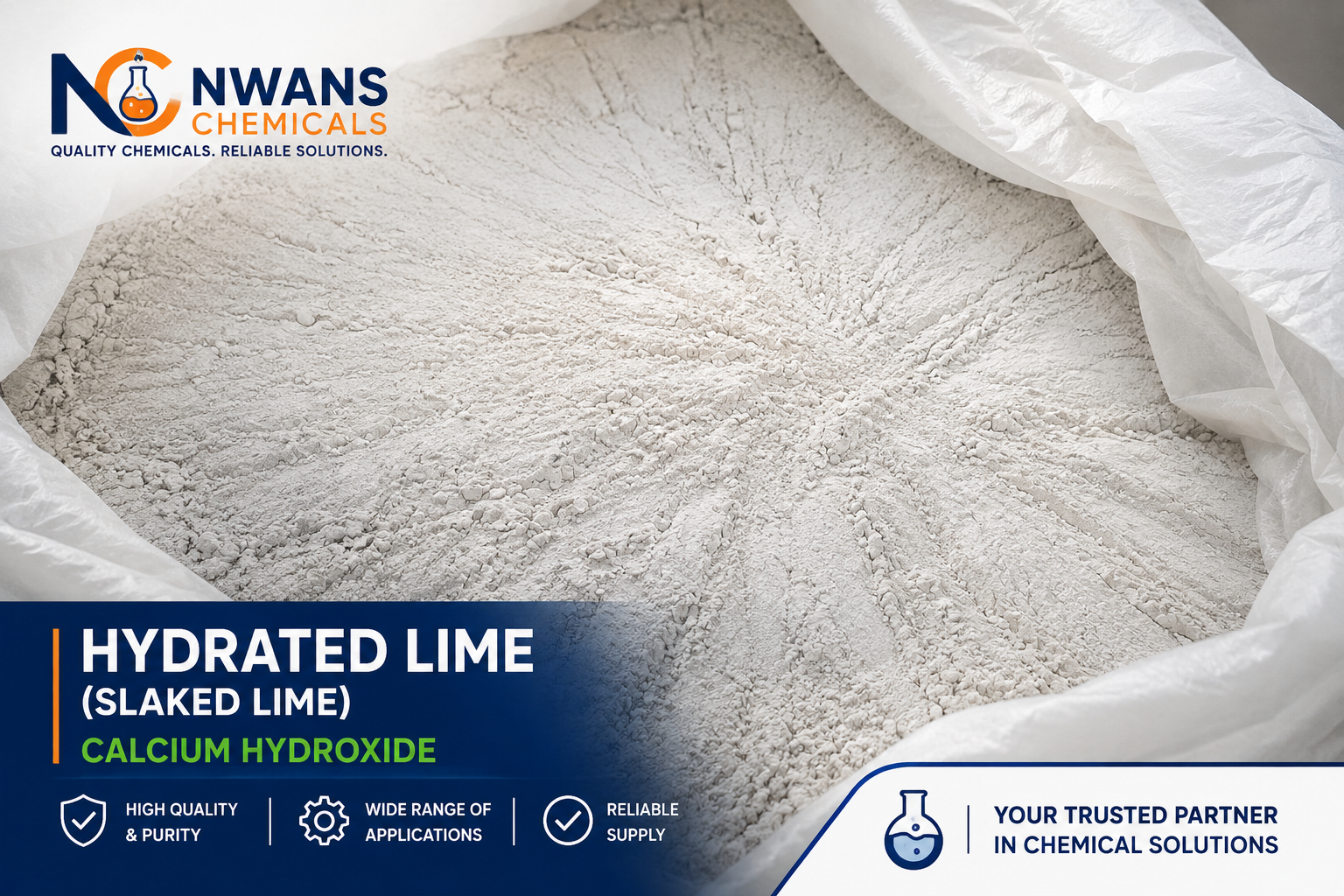
Hydrated lime, also known as slaked lime or calcium hydroxide (chemical formula Ca(OH)2), is produced by reacting quicklime (calcium oxide, CaO) with water in a process called slaking. This reaction is exothermic, releasing heat as calcium oxide converts to calcium hydroxide. Commercially, hydrated lime is supplied as a fine, dry white powder, and can be dosed either directly in dry form or mixed into a slurry (“milk of lime”) for easier, more controllable metering into process streams. Full technical and safety data on the compound is available via PubChem’s Calcium Hydroxide compound record.
Key Applications of Hydrated Lime
Hydrated Lime in Flotation pH Control
Hydrated lime is one of the most commonly used reagents in mineral flotation, valued for its ability to economically and efficiently raise pulp pH. It’s added at various points in the flotation circuit — typically as a Ca(OH)2 slurry — whenever alkalinity needs to be increased to optimize mineral separation. In lead-zinc flotation specifically, hydrated lime is often used to depress pyrite and sphalerite, helping plants achieve more selective separation of galena. Depending on the specific pulp chemistry, other alkalis such as soda ash or caustic soda may be used instead where lime’s calcium ions would otherwise interfere with target mineral recovery.
Hydrated Lime in Acid Mine Drainage (AMD) Treatment
Acid mine drainage — acidic, metal-laden water generated when sulfide minerals are exposed to air and water — is one of the most significant environmental challenges in mining. Hydrated lime is central to the most widely used AMD treatment method, the High-Density Sludge (HDS) process, where lime is added to raise pH to around 8–9, precipitating dissolved metals such as iron, aluminium, and manganese out of solution as stable hydroxides for removal.
Hydrated Lime in Water & Wastewater Treatment
Beyond mining, hydrated lime is used extensively in potable water treatment, industrial wastewater treatment, and sludge conditioning. It’s applied for pH correction, softening (removing hardness-causing calcium and magnesium), and as a coagulant aid to help settle suspended solids. Because of its relatively low solubility, hydrated lime is typically dosed as a lime slurry in continuous water treatment applications, allowing for more controlled, even dosing than dry powder alone.
Hydrated Lime in Industrial Neutralization
Hydrated lime is widely used as a general-purpose acid neutralizing agent across industrial processes, treating acidic effluent and process waste streams before discharge or further processing. Its relatively gentle, controllable reactivity compared to caustic soda makes it a practical choice in applications where cost and bulk availability matter more than reaction speed.
Hydrated Lime vs Caustic Soda: Choosing the Right Alkali
Hydrated lime and caustic soda are both used for pH correction in mining and water treatment, but they aren’t interchangeable in every application. Hydrated lime is generally more cost-effective per unit of alkalinity and is well suited to large-volume applications like AMD treatment, where bulk cost matters more than dosing precision. However, its low solubility in water means it’s slower-acting and can produce more sludge due to the calcium byproducts it forms. Caustic soda is fully soluble, faster-reacting, and produces less sludge, making it preferable in flotation circuits or leaching processes where calcium ions could interfere with mineral chemistry, or in applications needing rapid, precise pH control. Many operations use both reagents strategically across different stages of the same process. Nwans Chemicals supplies both hydrated lime and caustic soda flakes, pearls, and lye, giving your operation a single source for both alkalis.
Physical & Chemical Properties
| Property | Detail |
|---|---|
| Chemical name | Calcium Hydroxide |
| Also known as | Hydrated lime, slaked lime |
| Chemical formula | Ca(OH)2 |
| Appearance | Fine white powder |
| Solubility in water | Low; typically dosed as a slurry (“milk of lime”) for process use |
| Reactivity | Reacts with acids to neutralize; forms lime slurry with water |
| Storage | Store dry and sealed; can absorb moisture and carbon dioxide from air over time |
Note: Confirm exact specification and available purity/grade against the current product data sheet, as this can vary by production batch and intended application.
Hydrated Lime Supplier: Packaging & Supply
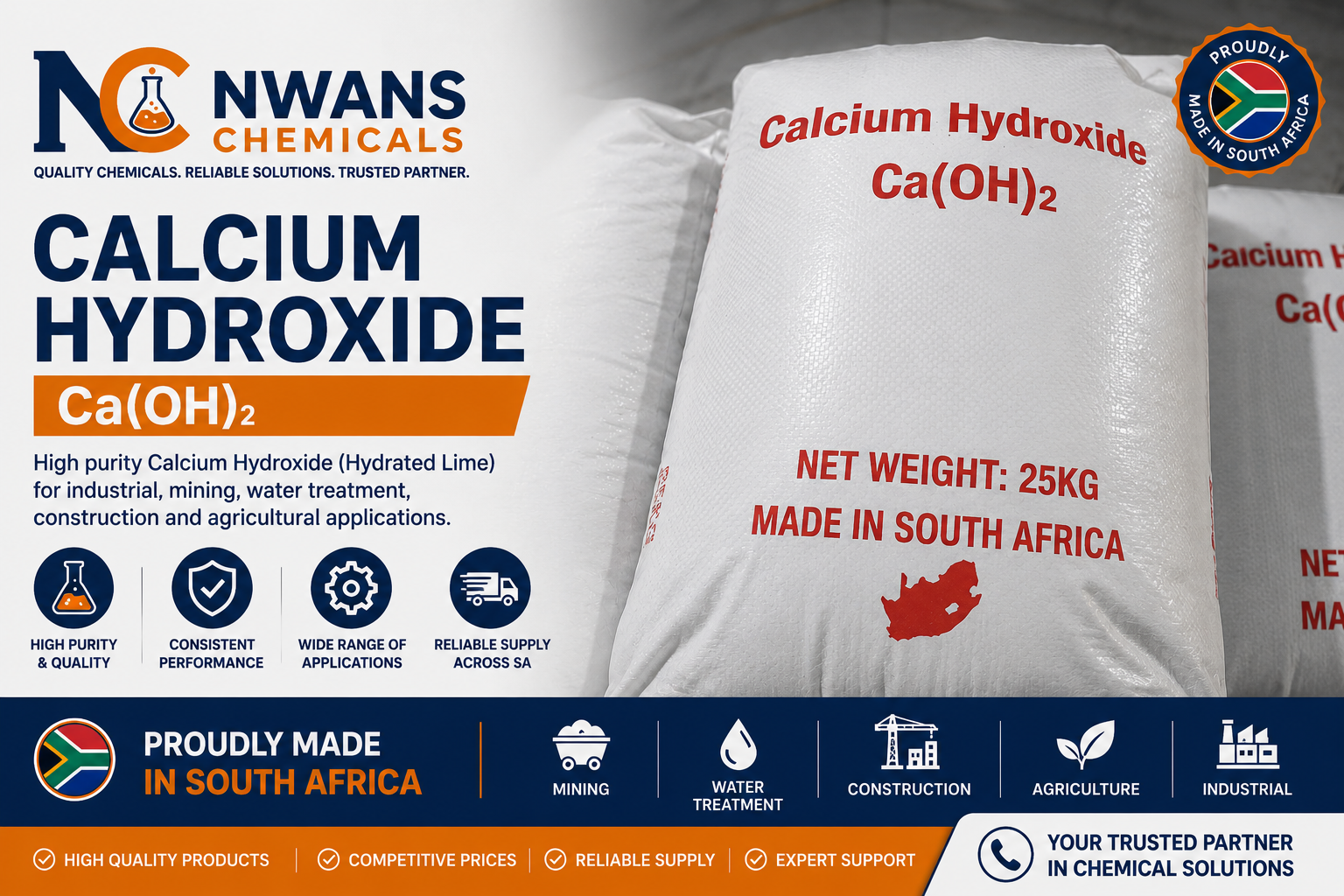
Nwans Chemicals supplies Hydrated Lime (Calcium Hydroxide / Slaked Lime) in packaging suitable for commercial and bulk industrial requirements.
Common packaging options include:
- 25 kg bags
- 50 kg bags
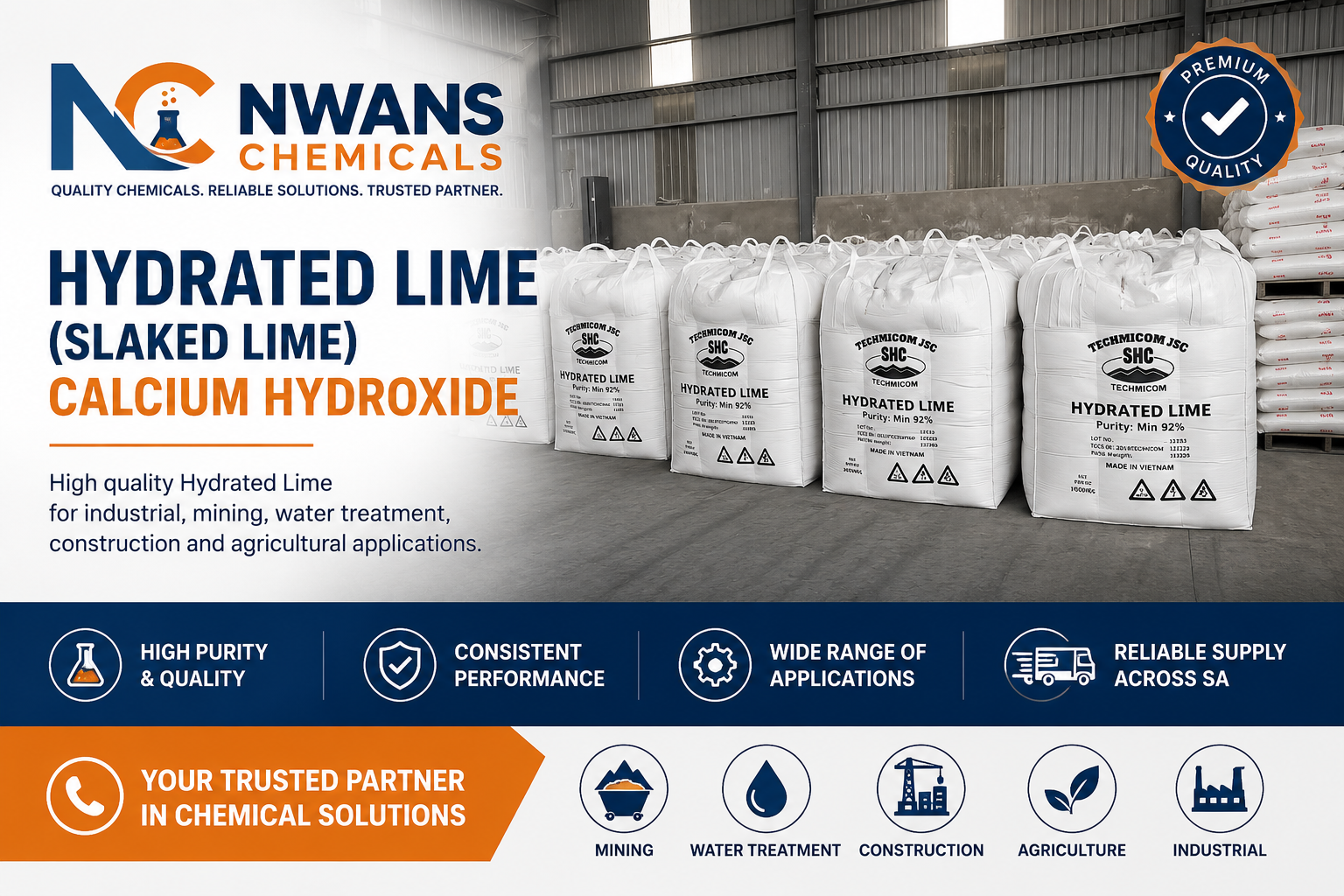
- 500 kg bulk/jumbo bags
- 1,000 kg (1 MT) FIBC jumbo bags
- 1.2 m³ bulk bags
- Palletised and shrink-wrapped bags
- Bulk pneumatic tanker supply for customers with suitable silo facilities
South African suppliers confirm several of these configurations, including 25 kg, 500 kg, 1-ton bulk bags and pneumatic tanker delivery.
Packaging and bulk supply options are subject to product grade, manufacturer, quantity and availability. Contact Nwans Chemicals for current packaging, stock and a quotation.
Handling & Safety
Hydrated lime is alkaline and requires proper precautions during handling and storage:
- Avoid inhalation of dust and contact with skin and eyes; hydrated lime is a known irritant, and appropriate PPE — including gloves, eye protection, and where needed respiratory protection — should be worn when handling
- Store in a dry, sealed area, since hydrated lime can absorb moisture and carbon dioxide from the air over time, gradually reducing reactivity
- When preparing lime slurry, add lime gradually to water under controlled mixing to manage the exothermic reaction and avoid splattering
- Be aware that lime slurries can cause scale buildup in pipes, troughs, and dosing equipment over time, so periodic system maintenance and cleaning should be planned
- Always request and review the current Safety Data Sheet (SDS) before first use at your site
Frequently Asked Questions
1. What is hydrated lime used for in mining? Hydrated lime is used primarily for pH control in flotation circuits and for neutralizing acid mine drainage, precipitating dissolved metals out of acidic mine water as part of the widely used High-Density Sludge (HDS) treatment process.
2. What’s the difference between hydrated lime and quicklime? Quicklime is calcium oxide (CaO), while hydrated lime is calcium hydroxide (Ca(OH)2), produced by reacting quicklime with water in a process called slaking. Hydrated lime is generally easier and safer to handle directly, since the exothermic slaking reaction has already occurred.
3. Should I choose hydrated lime or caustic soda for pH control? It depends on your application. Hydrated lime is typically more cost-effective for large-volume, less precision-sensitive applications like acid mine drainage treatment, while caustic soda offers faster, more soluble, more precise pH correction, and is often preferred where calcium byproducts would interfere with process chemistry.
4. Is hydrated lime dosed as a dry powder or a liquid slurry? Both are used, depending on the application. Continuous industrial processes commonly dose hydrated lime as a slurry (“milk of lime”) for more even, controllable dosing, while smaller or batch operations may use dry powder directly.
5. Is hydrated lime hazardous to handle? Hydrated lime is alkaline and can irritate skin, eyes, and the respiratory tract. Proper PPE and handling procedures should always be followed, and the current Safety Data Sheet (SDS) should be consulted before use.
6. Can I source both hydrated lime and caustic soda from the same supplier? Yes. Nwans Chemicals supplies both hydrated lime and caustic soda flakes, pearls, and lye, which are often used together or interchangeably across different stages of mining and water treatment processes, simplifying procurement for your operation.
Get a Quote From Your Hydrated Lime Supplier
Reliable pH control and water treatment performance start with consistent reagent quality. As a trusted hydrated lime supplier to South Africa’s mining and water treatment industries, Nwans Chemicals delivers bulk supply backed by documentation and dependable logistics. Contact us for a tailored quote today.
Reviews
There are no reviews yet.