
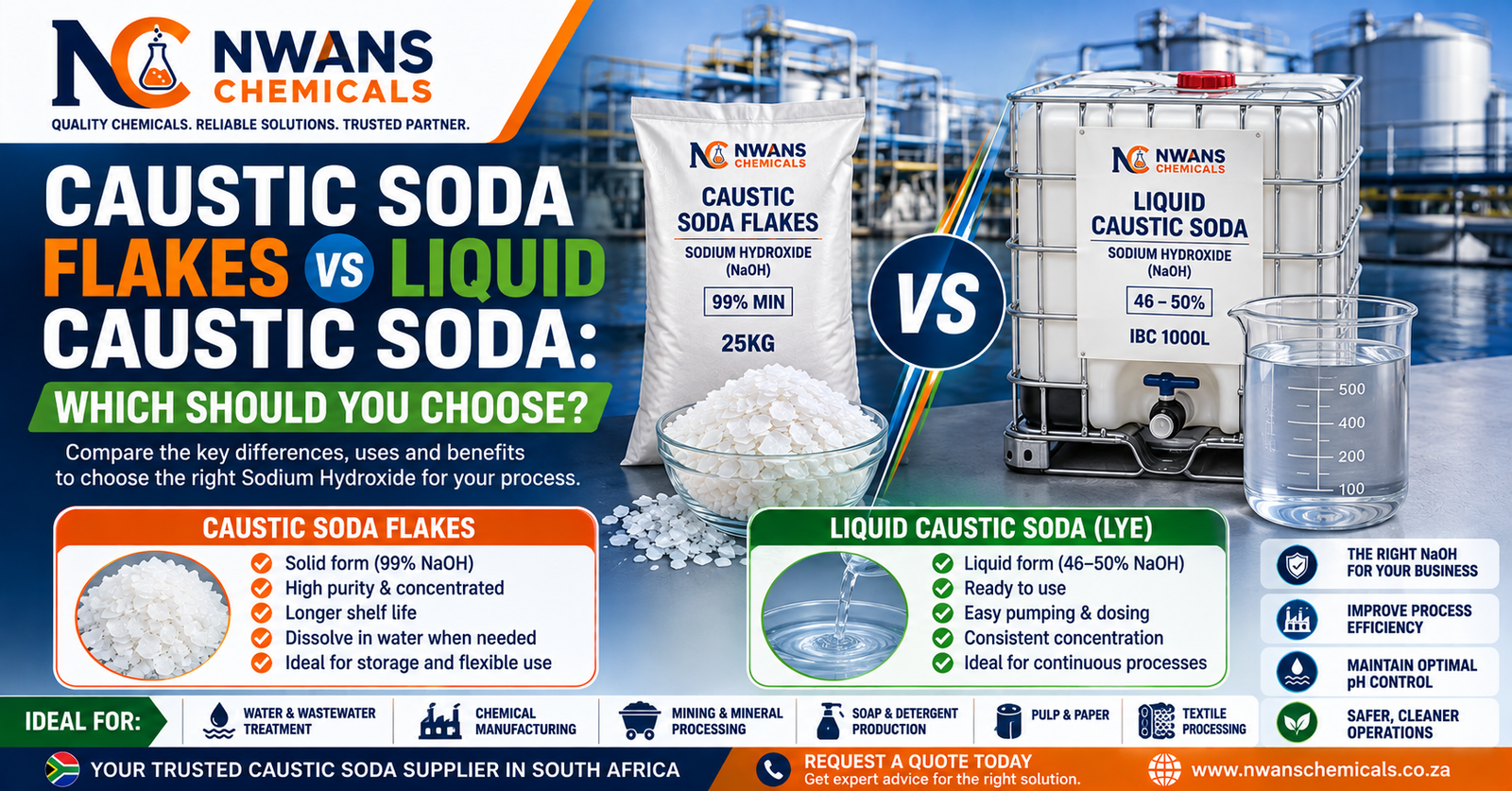
Caustic Soda Flakes vs Liquid Caustic Soda: Which Should You Choose?
Same chemical, two very different formats — and the choice between them affects your storage setup, dosing accuracy, and total delivered cost. If you’re deciding between caustic soda flakes and liquid caustic soda (lye) for your operation, this guide compares both forms across cost, handling, storage, and application to help you make the right call.
The Core Difference
Caustic soda flakes are solid sodium hydroxide, typically supplied at 98-99% purity. Liquid caustic soda (lye) is sodium hydroxide already dissolved in water, most commonly supplied at 32% or 50% concentration. Chemically, they’re the same active compound — the difference lies entirely in form, concentration, and how each behaves in storage, transport, and dosing.
Caustic Soda Flakes vs Liquid: Side-by-Side Comparison
| Factor | Flakes | Liquid Caustic Soda |
|---|---|---|
| Concentration | 98-99% NaOH | Typically 32% or 50% NaOH |
| Form | Solid, dry | Pre-dissolved aqueous solution |
| Freight efficiency | Higher NaOH per tonne shipped, since no water weight | Lower NaOH per tonne shipped, since water adds bulk weight |
| Storage | Dry, sealed storage; moisture-sensitive | Requires corrosion-resistant tanks; no dissolution needed |
| Dosing | Requires dissolving before use; manual or batch dosing common | Ready to dose directly via pump or metering system |
| Handling risk | Dust exposure; heat released when dissolving | Splash risk; requires bunded tank storage |
| Shelf life | Long, if kept dry and sealed | Can crystallize in cold conditions at high concentrations |
| Best suited to | Smaller operations, batch dosing, long-distance delivery | Continuous, high-volume dosing with existing tank infrastructure |
Cost Considerations: It’s Not Just About Price Per Tonne
Comparing flakes and liquid caustic soda purely on delivered price per tonne can be misleading, because the two products aren’t delivering the same amount of active chemical per tonne shipped. Flakes are concentrated at 98-99% NaOH, so nearly the entire shipped weight is active product. Liquid caustic soda is typically half water by weight, meaning you’re paying to transport water alongside the active chemical — which matters more the further your site is from the point of supply.
That said, liquid caustic soda can reduce labour and equipment costs on the receiving end, since it skips the dissolution step entirely — no dissolving tanks, no manual mixing, and less handling time per dose. The right comparison isn’t “which is cheaper per tonne,” but rather which form delivers the lowest total cost once you account for freight, storage infrastructure, and labour at your specific site and order volume.
Handling & Safety: Different Risks, Not Different Hazard Levels
Both forms are corrosive and require proper precautions — the difference is in what kind of risk you’re managing day to day.
Flakes generate dust during handling and release significant heat when dissolved in water, so dissolution must always be done by adding flakes to water — never the reverse — under controlled conditions with adequate ventilation.
Liquid caustic soda removes the dissolution step and its associated dust and heat risk, but introduces splash and leak risks during transfer, and requires dedicated bunded storage tanks built from corrosion-resistant materials. In colder conditions, concentrated liquid caustic soda can also partially crystallize, which can complicate unloading and handling if storage temperature isn’t managed.
Neither form is inherently “safer” — each shifts the risk profile to a different part of your process, which is why matching the form to your site’s existing infrastructure and safety procedures matters as much as the chemistry itself.
Which Applications Suit Flakes vs Liquid?
When Flakes Make Sense
Flakes are a strong fit for operations without existing bulk liquid storage infrastructure, smaller or batch-dosing processes, and sites receiving long-distance deliveries where minimising freight-on-water matters. This includes many soap and detergent manufacturers, smaller water treatment operations, and certain mining and mineral processing applications where manual or batch dosing is standard practice.
When Liquid Caustic Soda Makes Sense
Liquid caustic soda suits continuous, high-volume processes where tank storage and metering infrastructure are already in place, or where receiving-end labour savings outweigh the higher freight cost of transporting water. This is common in large-scale water treatment operations, pulp and paper processing, and industrial-scale detergent manufacturing running automated dosing systems.
Questions to Ask Before You Decide
- Does your site have bulk liquid storage and metering infrastructure, or would you need to install it?
- How far is your site from your supplier, and how much does freight-on-water affect your delivered cost?
- Is your dosing process manual/batch, or continuous and automated?
- Does your climate or storage environment risk crystallization of concentrated liquid caustic soda?
- Do you need the flexibility of long shelf-life dry storage, or is continuous supply guaranteed?
Get Expert Guidance on the Right Form for Your Operation
There’s no universally “better” option between caustic soda flakes and liquid caustic soda — the right choice depends on your process, infrastructure, and delivery logistics. Nwans Chemicals supplies both caustic soda flakes and liquid caustic soda (lye) across South Africa, and can advise on the best fit for your specific application — from mining chemical requirements to water treatment chemical supply.
Frequently Asked Questions
1. Is caustic soda flakes or liquid caustic soda cheaper? It depends on your distance from the supplier and site infrastructure. Flakes typically deliver more active NaOH per tonne shipped, which can make them more cost-effective over long freight distances, while liquid caustic soda can reduce on-site labour and equipment costs where bulk storage infrastructure already exists.
2. Which is safer to handle — flakes or liquid caustic soda? Both are corrosive and require proper PPE and procedures. Flakes carry dust and dissolution-heat risks, while liquid caustic soda carries splash and storage-related risks. Neither is inherently safer; the right choice depends on which risks your site is better equipped to manage.
3. Can I switch from flakes to liquid caustic soda (or vice versa) without changing my process? Usually not without some adjustment. Switching from flakes to liquid typically requires installing tank storage and metering equipment, while switching from liquid to flakes requires dissolution equipment and manual handling procedures.
4. Does liquid caustic soda go off or lose strength over time? Liquid caustic soda is generally stable, but concentrated solutions can crystallize in cold storage conditions, which can affect handling and require reheating before use.
5. Which form is better for water treatment applications? Both are used in water treatment. Liquid caustic soda tends to suit larger, continuous treatment operations with existing dosing infrastructure, while flakes or pearls are common in smaller-scale or batch treatment setups.
6. Do flakes and liquid caustic soda have the same purity? Not in the same sense — flakes are typically 98-99% NaOH by weight, while liquid caustic soda is a diluted solution (commonly 32% or 50% NaOH by weight), with the remainder being water.
Not Sure Which Form Fits Your Operation?
Whether you need caustic soda flakes or liquid caustic soda, Nwans Chemicals can help you choose the right form and quantity for your process. Contact us for a tailored quote today.
Leave A Comment