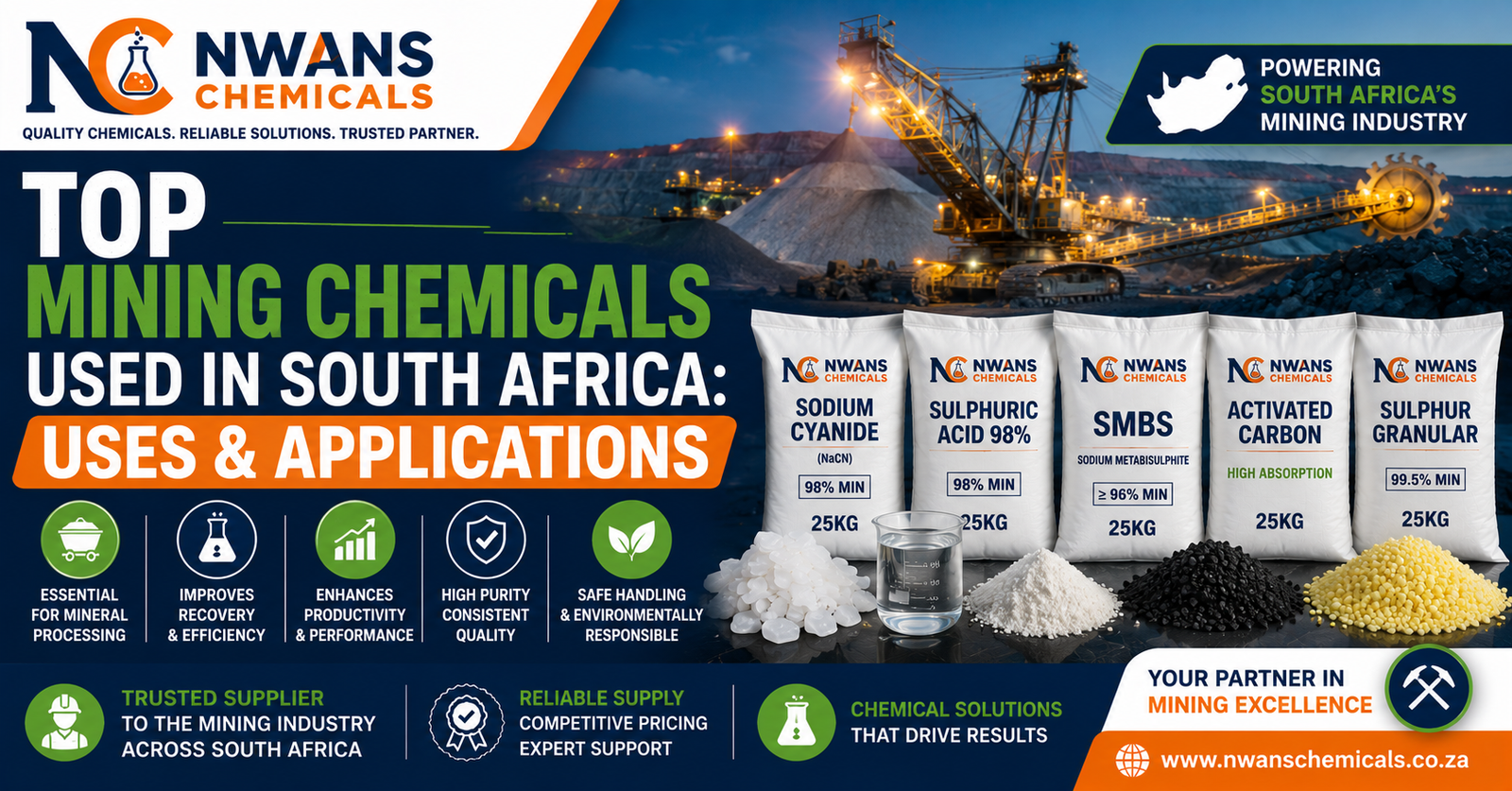
Top Mining Chemicals Used in South Africa: Uses & Applications
South Africa’s mining sector — spanning gold, platinum group metals, coal, and base metals — depends on a wide range of specialised chemicals to extract, process, and refine ore into usable metal. From flotation reagents that separate valuable minerals from waste rock to leaching agents that dissolve precious metals into solution, the right chemistry drives recovery rates, process efficiency, and safety. This guide covers the mining chemicals most widely used across South African mining operations, and where each one fits in the processing chain.
Why Chemical Selection Matters in Mining
Mineral processing is fundamentally a chemistry problem. Ore doesn’t separate into valuable mineral and waste rock on its own — it requires reagents that alter surface properties, control pH, dissolve target metals, or bind and remove impurities at each stage of the process. Choosing the right chemical, at the right purity and dosage, directly affects recovery rates, product grade, and operating cost. For procurement teams, that makes consistent chemical quality and reliable supply just as important as the underlying process design.
Flotation Reagents
Froth flotation is one of the most widely used methods for separating valuable sulfide minerals — such as copper, lead, zinc, and platinum group metals — from surrounding waste rock. Several categories of chemicals work together in this process:
- Collectors (such as xanthates, including SIBX and SIPX) make target minerals hydrophobic, so they attach to air bubbles and rise to the surface as froth, while waste material remains in the slurry
- Frothers stabilize the froth layer, allowing mineral-laden bubbles to be skimmed off efficiently
- Depressants (such as hydrated lime) selectively suppress unwanted minerals like pyrite, improving separation quality
- Activators (such as copper sulfate) enhance the flotation response of certain minerals, particularly in zinc and lead separation
Flotation chemistry is highly sensitive to pH, which is why alkaline reagents are used throughout the circuit to maintain optimal conditions for mineral separation.
Leaching Chemicals
Leaching is the process of dissolving target metals out of crushed ore using chemical reagents, and it’s central to gold, silver, and several base metal recovery processes.
- Sodium cyanide remains the standard leaching agent for gold and silver extraction, dissolving precious metals into a stable, soluble complex that can later be recovered
- Caustic soda (sodium hydroxide) plays a critical supporting role in cyanide leaching, maintaining the alkaline pH conditions cyanide requires to work safely and effectively — without adequate alkalinity, leaching efficiency drops and the risk of toxic hydrogen cyanide gas formation increases
- Emerging alternatives such as thiosulfate-based leaching are gaining attention as lower-environmental-impact options, though cyanide leaching remains the dominant method across most South African gold operations today
pH Modifiers and Alkalinity Control
Nearly every stage of mineral processing — flotation, leaching, and water treatment — depends on tightly controlled pH. Caustic soda is one of the most widely used alkalinity control chemicals across the industry, valued for its fast-acting, reliable pH correction in both flotation circuits and leaching processes. Depending on a site’s dosing infrastructure, operations use caustic soda flakes, caustic soda pearls, or liquid caustic soda (lye) — solid forms for manual or batch dosing, and liquid lye for continuous, automated dosing systems in larger operations. Lime is also commonly used as an alkalinity modifier, particularly as a flotation depressant.
Adsorption Chemicals
In gold processing specifically, activated carbon plays a key role in recovering dissolved gold from cyanide leach solutions. Gold-bearing cyanide solution is passed through activated carbon, which adsorbs the dissolved gold, allowing it to be later stripped and recovered — a process widely used in carbon-in-pulp (CIP) and carbon-in-leach (CIL) gold recovery circuits.
Solvents and Extractants
For base metal recovery — particularly copper, cobalt, and nickel — solvent extraction and electrowinning (SX-EW) processes rely on specialised extractant chemicals to selectively separate target metals from leach solutions before they’re recovered as high-purity metal through electrowinning. This chemistry is especially important in operations processing lower-grade or complex ores where direct smelting isn’t economical.
Water Treatment and Tailings Management Chemicals
Mining operations generate significant volumes of process and mine water that require treatment before reuse or discharge. Chemicals used in this space include:
- Flocculants and coagulants, which help settle suspended solids out of process water and tailings streams
- pH correction chemicals, including caustic soda, used to neutralize acidic mine water before treatment, reuse, or discharge — closely related to the broader water treatment chemical applications used across South African industry
- Tailings management chemicals, which help stabilize and neutralize mine waste, reducing long-term environmental risk and supporting compliance with discharge regulations
Coal Beneficiation Chemicals
In South Africa’s substantial coal sector, mining chemicals are also used in beneficiation — the process of removing impurities to improve coal quality before it reaches market. This supports both regulatory compliance and the commercial value of the final product.
What to Look for in a Mining Chemical Supplier
Given how directly chemical quality affects recovery rates and process stability, mining operations should prioritise suppliers who can provide:
- Consistent purity and specification, backed by a Certificate of Analysis for every batch
- Reliable, scheduled delivery, since interrupted chemical supply can halt processing circuits entirely
- Bulk packaging and logistics support suited to mine-site conditions, from bagged product to bulk and liquid delivery
- Technical understanding of mining applications, not just general industrial chemical supply
Frequently Asked Questions
1. What are the most commonly used chemicals in South African mining? Widely used mining chemicals include sodium cyanide for gold leaching, xanthate collectors and frothers for flotation, caustic soda for pH control, activated carbon for gold adsorption, and lime for flotation depression and pH correction.
2. Why is caustic soda used in mining? Caustic soda is primarily used to control pH in cyanide leaching and flotation circuits, maintaining the alkaline conditions these processes require for efficient, safe mineral recovery. It’s also used in mine water treatment.
3. What’s the difference between flotation reagents and leaching chemicals? Flotation reagents (collectors, frothers, depressants, activators) are used to physically separate valuable minerals from waste rock based on surface properties, while leaching chemicals chemically dissolve target metals out of ore into a solution for recovery.
4. Are there more environmentally friendly alternatives to cyanide leaching? Yes, alternatives such as thiosulfate-based leaching are being explored and adopted in some operations to reduce environmental impact, though cyanide leaching remains the dominant method for gold extraction due to its efficiency and established infrastructure.
5. What role does activated carbon play in gold mining? Activated carbon adsorbs dissolved gold from cyanide leach solutions in carbon-in-pulp (CIP) and carbon-in-leach (CIL) processes, allowing gold to be recovered from solution before final refining.
6. How does chemical quality affect mining operations? Inconsistent chemical purity can reduce recovery rates, disrupt process stability, and increase operating costs, which is why sourcing from a reliable supplier with verified specifications matters as much as the process design itself.
Source Reliable Mining Chemicals for Your Operation
From pH control to water treatment support, Nwans Chemicals supplies high-purity mining chemicals — including caustic soda flakes, pearls, and liquid lye — with full documentation and reliable delivery across South Africa. Contact us for a tailored quote today.
Leave A Comment